E-Way Bill FAQ: 30 Common Questions Answered
Short, practical answers to 30 common e-way bill questions on applicability, generation, Part A and Part B, distance, validity, cancellation, corrections, penalties and recent changes.
Last verified against official sources: 16 Oct 2026
Drafted with AI assistance, edited and fact-checked by a person. How we write and check our guides
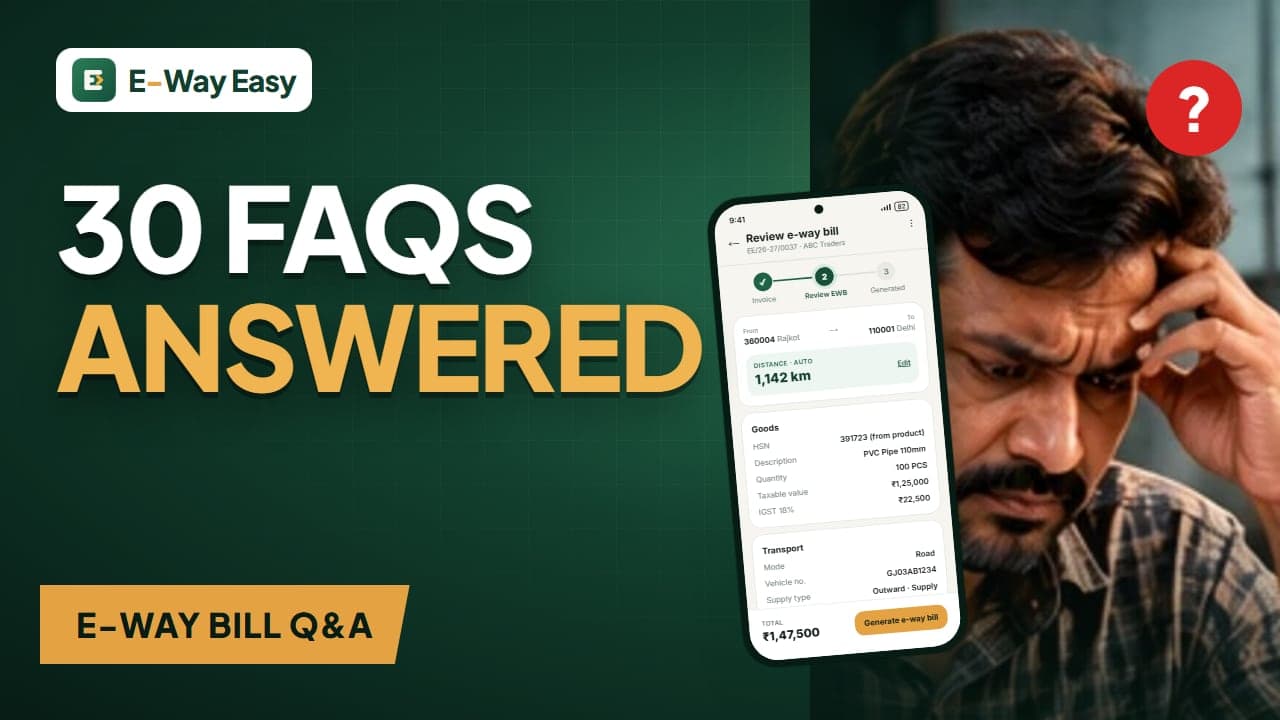
Table of contents
- Basics and applicability
- 1. What is an e-way bill?
- 2. Which law requires it?
- 3. What is the threshold?
- 4. Do states have different limits?
- 5. Is it needed when goods are not sold?
- 6. When is it required even below ₹50,000?
- 7. When is it not required?
- 8. Is it needed for services?
- Who generates and how
- 9. Who must generate it?
- 10. Can an unregistered transporter use the system?
- 11. What are the ways to generate it?
- 12. What documents do I need?
- 13. What goes into Part A and Part B?
- 14. Is Part B always needed?
- 15. Is login now protected by OTP?
- 16. What is the E-Way Bill 2.0 portal?
- Distance and validity
- 17. How is distance decided?
- 18. How long is an e-way bill valid?
- 19. When does a day end?
- 20. Can validity be extended?
- 21. What if it has expired?
- Changes, cancellation and acceptance
- 22. Can I edit an e-way bill?
- 23. How many times can I change the vehicle?
- 24. When can I cancel?
- 25. Can the buyer reject an e-way bill?
- 26. What is a consolidated e-way bill?
- Compliance and penalties
- 27. What must the driver carry?
- 28. What is the penalty for moving goods without a valid e-way bill?
- 29. Can I be blocked from generating e-way bills?
- Using E-Way Easy
- 30. How does the E-Way Easy app help?
- Quick action checklist
- Official sources
Quick answer: An e-way bill is generally required when goods move and the consignment value exceeds ₹50,000. It lasts 1 day per 200 km for normal cargo and can be cancelled within 24 hours. Part A cannot be edited, and validity can be extended within 8 hours before or after expiry.
Thirty questions that come up again and again at dispatch desks, each with a short answer and a link to the detailed guide. For the overall picture of how the system fits together, start with the E-Way Bill Guide.
Answers reflect the generally accepted position. Always check the latest notifications on the official e-way bill portal.
Basics and applicability
An e-way bill is needed when goods move and the consignment value exceeds ₹50,000, whether or not the movement is a sale. Some movements need one at any value, such as inter-state job work, and some goods are exempt under the Annexure to Rule 138(14). Services never need one, because the rule covers goods only.
Test the threshold on the consignment value of each document, including GST. A bill with a large exempt line can fall below ₹50,000 once that line is excluded.
1. What is an e-way bill?
An electronic document generated on the official system in Form GST EWB-01 before goods are moved. It records the supplier, recipient, goods, value, route and vehicle. The number is 12 digits today and, as reported by GSTN, 14 digits from 1 January 2027.
2. Which law requires it?
Section 68 of the CGST Act and Rule 138 of the CGST Rules, 2017, read with Rules 138A to 138E. See Rule 138 Explained.
3. What is the threshold?
Generally, consignment value above ₹50,000. Consignment value includes GST and cess but excludes the value of exempt supplies on the same invoice.
4. Do states have different limits?
Some states have notified a different limit for intra-state movement. Inter-state movement follows the general limit. Check your state's notification before relying on any figure.
5. Is it needed when goods are not sold?
Often yes. Stock transfer, job work, supply on approval, exhibition goods and sales returns can all need an e-way bill, usually against a delivery challan.
6. When is it required even below ₹50,000?
For inter-state movement of goods from a principal to a job worker, and inter-state transport of specified handicraft goods by a person exempt from registration.
7. When is it not required?
For goods and situations in the Annexure to Rule 138(14). Examples include non-motorised conveyance, certain exempt goods, and goods moving from a port, airport, air cargo complex or land customs station to an ICD or CFS for customs clearance. Read the current list before relying on it.
8. Is it needed for services?
No. Only goods.
Who generates and how
The registered supplier or recipient generates the e-way bill, and the transporter must do it if neither has and the value crosses the threshold. You can use the web portal, SMS, the official app, a bulk JSON upload, an API integration, or the IRN. Part A holds the invoice data; Part B holds the vehicle.
When you fill Part A, enter your transporter's ID. Without it, the transporter cannot update Part B on your behalf, and every vehicle change comes back to your desk.
9. Who must generate it?
The registered supplier or recipient. If neither does and the value is above the threshold, the transporter must generate it before movement.
10. Can an unregistered transporter use the system?
Yes. They enrol on the portal and receive a Transporter ID (TRANSIN).
11. What are the ways to generate it?
The web portal, SMS, the official mobile app, bulk upload of a JSON file made with the official Bulk Generation Tool, authorised API/GSP integration, and generation using the IRN for e-invoice taxpayers. See How to Generate.
12. What documents do I need?
A tax invoice, bill of supply, delivery challan or bill of entry, plus transporter and vehicle details or the transport document for rail, air or ship. Full list: Documents and Data Required.
13. What goes into Part A and Part B?
Part A: GSTINs, delivery PIN, document number and date, value, HSN and reason for transport; the Transporter ID and approximate distance are entered with Part A. Part B: mode of transport, vehicle number, and transport document number and date (LR, RR, airway bill or bill of lading).
14. Is Part B always needed?
For the e-way bill to be valid for movement, yes. The exception is goods moving within the same state up to 50 km from the consignor to the transporter, or from the transporter to the consignee. Part A is still required.
15. Is login now protected by OTP?
Yes. As reported by GSTN, multi-factor authentication was phased in from 1 January 2025 for larger taxpayers and extended to all taxpayers from 1 April 2025. Keep the registered mobile with someone who is present when bills are made.
16. What is the E-Way Bill 2.0 portal?
An additional official portal at ewaybill2.gst.gov.in, launched by GSTN/NIC in 2024, with data synchronised with the main portal for continuity.
Distance and validity
Validity depends on distance: 1 day per 200 km or part for normal cargo, and 1 day per 20 km or part for over-dimensional cargo. The portal calculates distance from PIN codes, and you may enter up to 10% more. Each day ends at midnight, and validity counts from when Part B is first entered.
Because the clock starts with Part B, you can fill Part A in advance. Add Part B only when the vehicle is ready to load, so the bill does not lose hours of validity while the truck waits.
17. How is distance decided?
The portal calculates PIN-to-PIN distance. You can enter up to 10% more if the actual route is longer, with a maximum of 4,000 km and up to 100 km for the same PIN code. See Distance Rules.
18. How long is an e-way bill valid?
1 day for every 200 km or part (normal cargo); 1 day for every 20 km or part (over-dimensional cargo). See Validity.
19. When does a day end?
At midnight. The first day ends at midnight of the day after generation (or after Part B is first entered).
20. Can validity be extended?
Yes, within 8 hours before or after expiry, when goods cannot reach on time because of exceptional circumstances. As reported by GSTN, from 1 January 2025 total extension is capped at 360 days from original generation.
21. What if it has expired?
If the 8-hour window has passed, it cannot be extended. A fresh e-way bill is needed before the goods move further.
Changes, cancellation and acceptance
Once generated, an e-way bill cannot be edited. You can update Part B, change the transporter, extend validity or cancel within 24 hours. The recipient can accept or reject it within 72 hours or before delivery, whichever is earlier; if they do nothing, it is treated as accepted.
Cancel a wrong bill as soon as you spot the error. Once an officer has verified it in transit, cancellation is blocked even inside the 24 hours.
22. Can I edit an e-way bill?
No. You can update Part B, change the transporter and extend validity. Part A errors need cancellation and a new e-way bill. See Correction.
23. How many times can I change the vehicle?
Any number of times while the e-way bill is valid, through a Part B update.
24. When can I cancel?
Within 24 hours of generation, if not verified in transit. See Cancellation.
25. Can the buyer reject an e-way bill?
Yes, within 72 hours of the details being made available or before delivery, whichever is earlier. If they do nothing, it is deemed accepted.
26. What is a consolidated e-way bill?
Form GST EWB-02, generated by the transporter to cover several consignments, each with its own e-way bill, travelling in one vehicle. As reported by GSTN, its number grows from 10 to 11 digits from 1 January 2027.
Compliance and penalties
The driver must carry the invoice, bill of supply or delivery challan, plus the e-way bill as a printout, number or RFID mapping. Moving goods without a valid bill can lead to detention, seizure and a penalty under Section 129. Not filing returns can also block you from generating new e-way bills.
A return-filing block is the costliest of these, because it stops every outward consignment at once. If you dispatch goods every day, treat return deadlines as dispatch deadlines.
27. What must the driver carry?
The invoice, bill of supply or delivery challan, and the e-way bill as a printout, the EWB number, or mapped to an RFID device on the vehicle.
28. What is the penalty for moving goods without a valid e-way bill?
Goods and the vehicle can be detained or seized, and a penalty imposed under Section 129 of the CGST Act. The amount can be substantial, and Section 122 general penalties can also apply.
29. Can I be blocked from generating e-way bills?
Yes. Under Rule 138E, generation can be blocked for taxpayers who have not filed returns for the prescribed period. Filing the pending returns is the usual way to get access back, once the system updates.
Using E-Way Easy
E-Way Easy is an independent Android app, not a government portal, that prepares the invoice and e-way bill in one flow and files on the official system through an authorised GSP. It works one invoice at a time. Each e-way bill action costs 5 credits, refunded automatically if the portal rejects it.
30. How does the E-Way Easy app help?
It follows a three-step workflow, Invoice → Review EWB → Generated, with saved buyers and products, buyer address from GSTIN, HSN from your product list, and distance from PIN codes (all editable). The app is ready for the 14-digit e-way bill numbers. Bulk generation is not a claimed feature; see features.
Quick action checklist
- Confirm your state's intra-state threshold on the official portal.
- Add your regular transporters' IDs to your records so Part A always carries one.
- Fill Part B only when the vehicle is ready to load.
- Diarise the 24-hour cancellation and 8-hour extension windows for every bill.
- Keep return filing on time so generation is never blocked.
Want to know exactly when a bill will expire? Enter the distance and generation time in the free e-way bill validity and distance calculator.
Official sources
Read the detailed guides linked above and the official user documentation for current procedures. Rules change through notifications and portal advisories, so confirm on the e-way bill portal. For complex or high-value situations, consult a qualified tax professional.
Frequently asked questions
What is the e-way bill limit in India?
Generally ₹50,000 of consignment value, including GST but excluding exempt supplies on the same invoice. Some states have a different limit for intra-state movement, so check your state's notification.
Who has to generate the e-way bill?
The registered supplier or the recipient. If neither has done so and the value exceeds the threshold, the transporter must generate it before the goods move.
Is Part B compulsory?
Yes for movement, except when goods move within the same state up to 50 km between the consignor and the transporter, or the transporter and the consignee. Part A is always needed.
How is validity calculated?
1 day per 200 km or part for normal cargo, and 1 day per 20 km or part for over-dimensional cargo. The first day ends at midnight of the next day.
Can I cancel an e-way bill?
Yes, within 24 hours of generation, provided it has not been verified in transit. After that, the portal does not allow cancellation.
Can I edit an e-way bill?
No. Part B (vehicle) and the transporter can be updated. Part A errors need cancellation within 24 hours and a fresh e-way bill.
Can I generate an e-way bill for an old invoice?
As reported by GSTN, from 1 January 2025 the base document cannot be more than 180 days old on the date of generation. Older invoices are blocked by the portal.
Is an e-way bill needed for services?
No. The e-way bill applies to the movement of goods only. A pure service invoice never needs one.
Sources and references
- E-Way Bill System (official portal)ewaybillgst.gov.in
- E-Way Bill 2.0 portalewaybill2.gst.gov.in
- E-Way Bill user documentationdocs.ewaybillgst.gov.in
- CBIC GST (CGST Act and Rules)cbic-gst.gov.in
- GST tutorialstutorial.gst.gov.in
This article is general information, not tax or legal advice. GST and e-way bill requirements depend on the transaction, applicable notifications and state-specific provisions. Check the official portals before you rely on it.
Editorial update history
- Added a direct answer and a practical tip to each question group, noted the 14-digit e-way bill number from January 2027, and added a quick action checklist.
- Corrected the Part A / Part B answer: the transport document number belongs in Part B.
- First published.
Written by
Bhavesh AkabariBhavesh Akabari writes and edits the E-Way Easy guides on e-way bills, GST invoicing and day-to-day compliance workflows for Indian manufacturers, wholesalers and traders. Drafts are prepared with AI assistance; he edits each one and checks the facts against official GST and e-way bill sources, and every compliance article carries a "last verified" date.
How we create contentMore e-way bill guides
E-Way Bill Guide: Everything Indian Businesses Need to Know
A practical overview of the e-way bill system in India: what it is, when it is required, who generates it, how Part A and Part B work, validity, and links to every detailed guide.
E-Way Bill Rules in India (Rule 138 Explained)
Rule 138 of the CGST Rules explained in plain language: legal basis, the ₹50,000 threshold, consignment value, who generates, Part A and Part B, exemptions, validity, cancellation, acceptance, verification and penalties.
E-Way Bill Validity: Calculation, Extension and Expiry
How e-way bill validity is calculated for normal and over-dimensional cargo, when the clock starts and ends, how to extend an expiring bill, and what to do if it expires, with timestamped examples.
Common E-Way Bill Errors and How to Fix Them
The everyday problems businesses face while generating e-way bills, explained in plain words: GSTIN issues, duplicate documents, distance rejections, tax mismatches, login trouble, expired bills and more, with practical fixes.