E-Way Bill Number Becomes 14 Digits from 1 January 2027: What Changes
GSTN has announced that e-way bill numbers grow from 12 to 14 digits and consolidated e-way bill numbers from 10 to 11 digits from 1 January 2027. What changes, what doesn't, and what to check.
Drafted with AI assistance, edited and fact-checked by a person. How we write and check our guides
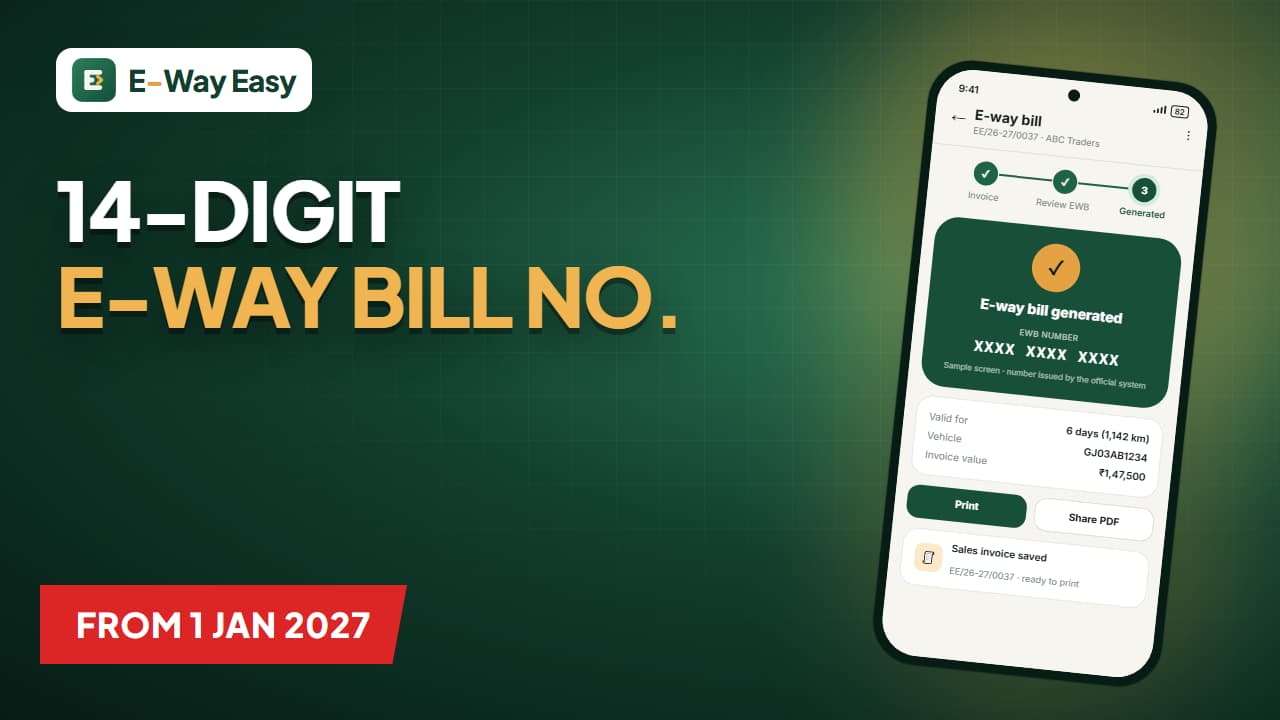
Table of contents
Quick answer: According to a GSTN advisory dated 4 November 2026, from 1 January 2027 the e-way bill number grows from 12 digits to 14 digits and the consolidated e-way bill number from 10 digits to 11 digits, because the existing number range is running out. The rules themselves do not change. What you need to check is anywhere the number is stored, typed, validated or printed: ERP and billing software, spreadsheets and transport documents.
What is changing
| Number | Until 31 December 2026 | From 1 January 2027 |
|---|---|---|
| E-way bill number (EBN) | 12 digits | 14 digits |
| Consolidated e-way bill number | 10 digits | 11 digits |
The reason given is capacity: so many e-way bills are generated every day that the 12-digit range is expected to be used up. A longer number simply creates room for more.
This article is based on the GSTN advisory as reported by several tax publications. We could not open the advisory itself on the official portals at the time of writing, so confirm the final technical details on the e-way bill portal before you change your systems.
What does not change
- Whether you need an e-way bill: the ₹50,000 consignment value test and the exceptions stay as they are. See the ₹50,000 limit and its exceptions.
- Who generates it: supplier, recipient or transporter, as before.
- Part A and Part B, validity, extension, cancellation and rejection rules.
- E-way bills already generated: they keep their existing numbers. Expect to see both lengths in your records for a while.
Who needs to act
Businesses whose software talks to the e-way bill system. If your ERP, billing software or a GST Suvidha Provider (GSP) generates e-way bills through the API, the software has to accept, store and display a 14-digit number. A common failure is a database column or validation rule that allows exactly 12 characters: the e-way bill is generated on the portal, but your system rejects or cuts the number it gets back. GSTN has said test changes will be available in its sandbox; ask your software provider when they have tested them.
Anyone who keeps e-way bill numbers in Excel. Excel shows long numbers in scientific notation (for example 1.23457E+13) and drops leading zeros. Format the e-way bill number column as Text before you paste numbers in, and check any lookup formulas that match on the number.
Transporters and dispatch desks. Check printed lorry receipts, dispatch registers, gate passes and any form with a fixed number of boxes for the e-way bill number. Drivers who read the number out at checkpoints should know it is longer.
People who generate on the portal by hand. The portal shows whatever number it issues, so generation itself needs no change. Only your own records and formats need checking.
A short checklist before 1 January 2027
- List every place the e-way bill number is stored or typed: ERP, billing software, spreadsheets, transport documents, reports.
- Ask your ERP or GSP provider to confirm their 14-digit and 11-digit changes are tested.
- Change fixed-length fields and validation rules to accept the new lengths, while still accepting the old ones.
- Format spreadsheet columns that hold e-way bill numbers as Text.
- Update printed formats and registers that have room for only 12 digits.
- After 1 January 2027, check your first few e-way bills end to end: generation, Part B update, cancellation and consolidation.
Example (illustrative)
A Rajkot pipe manufacturer keeps a dispatch register in Excel and generates e-way bills from its billing software through a GSP. In December 2026 it formats the register's e-way bill column as Text and asks the GSP for confirmation that its integration accepts 14-digit numbers. On 2 January 2027 it generates its first e-way bill of the year, checks that the full 14-digit number appears in the billing software, on the printed invoice and in the register, and only then continues normal dispatch.
Where E-Way Easy fits
The E-Way Easy app is ready for 14-digit e-way bill numbers. If you generate e-way bills in the app, there is nothing to change in the app on your side. Your own spreadsheets and printed formats still need the checks above.
If you prepare dispatch data in spreadsheets, the free bulk e-way bill data checker helps you clean the file before uploading it on the portal, and our guides on Part A and Part B and e-way bill validity still apply unchanged.
Official sources
Rules and technical specifications are published on the e-way bill portal, its user documentation and the GST portal news and updates. This article will be updated once the advisory text and final specifications are confirmed there.
Frequently asked questions
When does the e-way bill number become 14 digits?
From 1 January 2027, according to the GSTN advisory dated 4 November 2026. E-way bills generated from that date carry a 14-digit number instead of 12 digits.
Does the consolidated e-way bill number change too?
Yes. The consolidated e-way bill number grows from 10 digits to 11 digits from the same date.
Do the ₹50,000 limit or validity rules change?
No. This is a change to the length of the number only. Who must generate an e-way bill, the value threshold, validity, Part A and Part B and the other rules stay the same.
What happens to e-way bills generated before 1 January 2027?
Numbers already issued are not renumbered, as reported. Your systems and records need to handle both the old 12-digit numbers and the new 14-digit numbers side by side.
I generate e-way bills on the portal by hand. Do I need to do anything?
Usually very little. Check anything where you type or store the number yourself: spreadsheets, dispatch registers, printed formats and any software that has a fixed 12-character field.
Is the E-Way Easy app ready for 14-digit e-way bill numbers?
Yes. The E-Way Easy app is ready for the 14-digit e-way bill number, so there is nothing to change in the app on your side. Check your own spreadsheets, registers and printed formats.
Sources and references
- E-Way Bill System (official portal)ewaybillgst.gov.in
- GST portal: news and updateswww.gst.gov.in/newsandupdates
- E-Way Bill user documentationdocs.ewaybillgst.gov.in
This article is general information, not tax or legal advice. GST and e-way bill requirements depend on the transaction, applicable notifications and state-specific provisions. Check the official portals before you rely on it.
Written by
Bhavesh AkabariBhavesh Akabari writes and edits the E-Way Easy guides on e-way bills, GST invoicing and day-to-day compliance workflows for Indian manufacturers, wholesalers and traders. Drafts are prepared with AI assistance; he edits each one and checks the facts against official GST and e-way bill sources, and every compliance article carries a "last verified" date.
How we create contentRelated articles
What Is an E-Way Bill? A Complete Guide for Indian Businesses
A plain-English guide to the e-way bill: what it is, when you need one, who generates it, its two parts, validity and the mistakes that cause trouble on the road.
By Bhavesh Akabari · · 8 min read
E-Way Bill Part A and Part B Explained
What goes into Part A and Part B of Form GST EWB-01, who fills each part, when Part B can be skipped, and how to correct mistakes in either part.
By Bhavesh Akabari · · 5 min read
How to Prepare Invoice Data for Bulk Processing
Set up a clean invoice spreadsheet, run simple validation checks and remove duplicates before you upload data for bulk e-way bills or returns.
By Bhavesh Akabari · · 8 min read