Who Is Responsible for Generating an E-Way Bill?
Supplier, recipient or transporter? How responsibility for the e-way bill is split, what each party must do, and how to avoid goods leaving without one.
Last verified against official sources: 16 Oct 2026
Drafted with AI assistance, edited and fact-checked by a person. How we write and check our guides
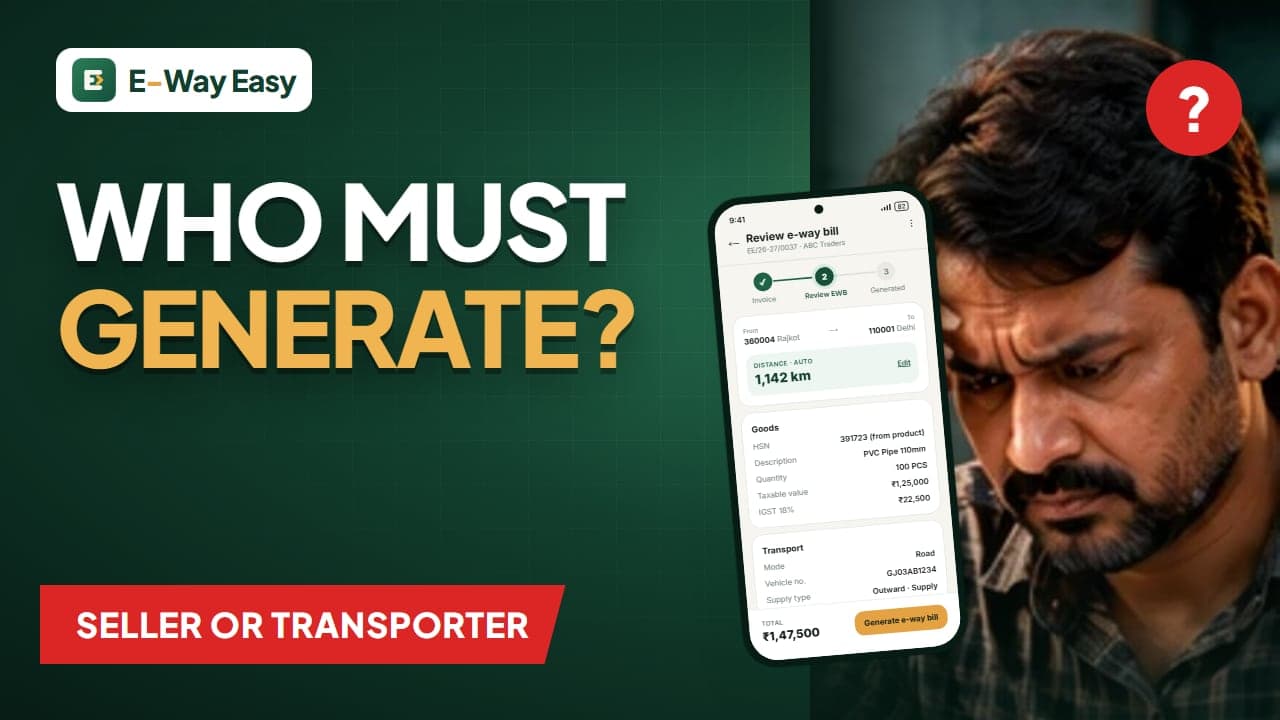
Table of contents
- The short answer
- Responsibility by party
- Scenario-by-scenario
- 1. Registered supplier sells and arranges transport
- 2. Buyer collects goods in their own vehicle
- 3. Supplier hands goods to a transporter without generating
- 4. Purchase from an unregistered supplier
- 5. Transporter not registered under GST
- 6. Goods changing vehicles mid-route
- Example (illustrative): buyer's transporter collects
- Liability does not move with the task
- Who can cancel, update, extend and reject
- Common mistakes
- Quick action checklist
- Official sources
Quick answer: The registered person causing the movement, usually the supplier or the recipient, generates the e-way bill. The transporter can generate it on their behalf. If neither has generated it and the value exceeds the threshold, the transporter must do so before the goods move.
"I thought the transporter was doing it" and "the buyer said they would generate it" are how most cases of goods moving without an e-way bill begin. Three parties can generate one, which is flexible, but it also lets everyone assume someone else did.
The short answer
Under Rule 138 of the CGST Rules, the registered person causing the movement generates the e-way bill, usually the supplier, or the recipient if the recipient causes the movement. A transporter can generate it from the supplier's or recipient's documents. And if neither party has generated it above the threshold, the transporter must, before the goods move.
So the rule has two layers:
- Who can generate: the registered supplier, the registered recipient, or the transporter on their documents.
- Who must, as a fallback: the transporter, where neither party has generated one and the consignment value exceeds the threshold.
The fallback catches transporters off guard. A transporter who loads goods above the threshold without an e-way bill is not just helping out. The duty has landed on them.
Responsibility by party
Each party has a different job around the same e-way bill. The supplier owns the invoice data in Part A; the recipient generates when it arranges transport or buys from an unregistered supplier, and can accept or reject. The transporter fills or updates Part B, and generates when the parties have not.
| Party | Can generate? | Typical role | Key duty |
|---|---|---|---|
| Registered supplier | Yes | Generates Part A from their invoice; may also fill Part B | Correct invoice-level data |
| Registered recipient | Yes | Generates when they arrange transport or buy from unregistered suppliers | Accept or reject within 72 hours |
| Transporter (GSTIN or TRANSIN) | Yes | Fills or updates Part B; generates when parties haven't | Must not move goods above threshold without a valid e-way bill |
| Unregistered supplier | Can enrol on the portal | Supplies to a registered buyer | Where the recipient is registered and known, the movement is treated as caused by the recipient |
The transporter's ability to update Part B depends on one field: its GSTIN or TRANSIN must be entered on the e-way bill. If it is missing, the transporter cannot act on it, and every vehicle change becomes a call back to the supplier. For the field-by-field view, see Part A and Part B explained.
Scenario-by-scenario
The right generator depends on who arranges the movement and who is registered. In a normal sale the supplier generates, when the buyer collects either can, and when goods reach a transporter without one, the transporter must. Purchases from unregistered suppliers fall to the registered recipient, and vehicle changes to whoever is in charge.
1. Registered supplier sells and arranges transport
This is the most common case. The supplier generates Part A from the invoice and fills Part B with the vehicle number. Or the supplier names the transporter so the transporter can fill Part B.
2. Buyer collects goods in their own vehicle
The registered recipient is causing the movement, so the recipient can generate. In practice the supplier often generates anyway, because it has the invoice data. Either is fine, but agree who will do it before the vehicle arrives.
3. Supplier hands goods to a transporter without generating
If the value exceeds the threshold and neither party has generated one, the transporter must generate it before moving the goods. It uses the invoice or challan handed over.
4. Purchase from an unregistered supplier
If the recipient is registered, the movement is treated as caused by the recipient. The recipient generates the e-way bill as an inward movement, using the supplier's bill or its own document as the base.
5. Transporter not registered under GST
Many small transport operators are not registered. They enrol on the e-way bill portal to get a TRANSIN (Transporter ID), which goes on the e-way bill so they can update Part B.
6. Goods changing vehicles mid-route
Whoever is in charge, usually the transporter, updates Part B before the goods move in the new vehicle. Several consignments in one vehicle can go under a consolidated e-way bill (Form GST EWB-02), generated by the transporter. See how to update vehicle details.
Example (illustrative): buyer's transporter collects
This example shows a sale where the supplier makes the supply but the buyer arranges transport. Either can generate, and the transporter must if neither does. The arrangement that works best splits the job: the supplier makes Part A from its invoice and names the transporter, who fills Part B at pickup.
A Jaipur handicraft wholesaler sells goods to a retailer in Delhi. The invoice is ₹48,000 + 5% GST (₹2,400) = ₹50,400. The retailer's transporter collects the goods.
- Who is causing the movement? The supplier is making the supply; the recipient is arranging transport.
- Who should generate? Either the supplier or the recipient. The transporter must generate if neither does.
- Sensible arrangement: the wholesaler generates Part A from the invoice and enters the transporter's GSTIN or TRANSIN. The transporter fills Part B with the vehicle number on pickup.
- Result: one e-way bill, clear ownership, and the truck does not leave without Part B.
(GST rate is illustrative; confirm the correct rate for your goods.)
Liability does not move with the task
Handing e-way bill generation to a transporter does not remove your interest in getting it right. If the bill is missing or wrong, goods and the vehicle can be detained, and a penalty under Section 129 can apply. The goods are yours, and so is the delay, so check the e-way bill number and key details before the vehicle leaves.
A simple control helps: ask the transporter to send the e-way bill number before the truck leaves your gate, and note it against the invoice. If no number arrives, the truck waits. That one rule removes most "I thought you did it" cases.
Who can cancel, update, extend and reject
After generation, each action belongs to a specific party. The generator can cancel within 24 hours if goods did not move or did not move as described, unless it was verified in transit. The generator or assigned transporter updates Part B, extensions go to the generator or transporter, and rejection belongs to the recipient.
- Cancel: the generator, within 24 hours, if goods were not moved or not moved as per details, and only if not verified in transit.
- Update Part B / change transporter: the generator or the assigned transporter, during validity.
- Extend validity: the generator or the transporter in charge, within 8 hours before or after expiry, for exceptional circumstances.
- Reject: the recipient, within 72 hours or before delivery, if earlier.
Recipients often forget the last one. E-way bills generated against your GSTIN are deemed accepted if you do nothing within the window. Someone in accounts should glance at them, so a wrong one gets rejected while it still can be.
Common mistakes
Responsibility mistakes come from unclear ownership, not from the law. There is no written agreement on who generates, the transporter ID is left blank, the recipient ignores e-way bills against its GSTIN, or the supplier assumes the buyer's truck means no duty. An unregistered transporter without a TRANSIN cannot act on the e-way bill at all.
- No written agreement on who generates. Put it in the PO, the transport contract or a dispatch SOP.
- Transporter ID not entered. The transporter can't update Part B if they aren't assigned.
- Recipient ignoring e-way bills against their GSTIN. Unchecked bills are deemed accepted after 72 hours.
- Supplier assuming the buyer's vehicle means no responsibility. The supplier's invoice data still drives Part A.
- Unregistered transporter without TRANSIN. Enrol on the portal before taking consignments that need e-way bills.
Quick action checklist
- Add one line to your PO and transport terms that names who generates the e-way bill.
- Collect the GSTIN or TRANSIN of every transporter you use and keep it on file.
- Make "no e-way bill number, no gate pass" a rule at the dispatch gate.
- Have accounts review e-way bills against your GSTIN within the 72-hour window.
- Decide who handles cancellation, Part B updates and extensions for each route.
For most small suppliers, the simplest choice is to generate the e-way bill yourself at invoicing time. See the E-Way Easy app features to check whether creating the invoice and e-way bill in one flow suits your dispatch desk.
Official sources
The responsibilities are set out in Rule 138 of the CGST Rules on CBIC GST. TRANSIN enrolment and transporter functions are explained on the E-Way Bill System and in the user documentation. E-Way Easy is an independent app, not a government portal.
Frequently asked questions
Can a transporter generate the e-way bill on behalf of the supplier?
Yes. The transporter can generate it from the invoice or challan the supplier hands over. If neither the supplier nor the recipient has generated it and the value exceeds the threshold, the transporter must do so before the movement.
What if my supplier is unregistered?
If you, the recipient, are registered, the movement is treated as caused by you. You can generate the e-way bill as an inward movement, provided the rules require one for that movement.
Do unregistered transporters need a GSTIN?
No. They can enrol on the e-way bill portal and get a Transporter ID (TRANSIN). That ID is named on e-way bills so they can update Part B.
If the buyer sends their own truck, is the supplier off the hook?
No. Either the supplier or the registered buyer can generate, but someone must do it before the truck leaves. The supplier's invoice still drives Part A, so agree in writing who generates.
Sources and references
- E-Way Bill System (official portal)ewaybillgst.gov.in
- E-Way Bill user documentationdocs.ewaybillgst.gov.in
- CBIC GST (CGST Rules)cbic-gst.gov.in
This article is general information, not tax or legal advice. GST and e-way bill requirements depend on the transaction, applicable notifications and state-specific provisions. Check the official portals before you rely on it.
Written by
Bhavesh AkabariBhavesh Akabari writes and edits the E-Way Easy guides on e-way bills, GST invoicing and day-to-day compliance workflows for Indian manufacturers, wholesalers and traders. Drafts are prepared with AI assistance; he edits each one and checks the facts against official GST and e-way bill sources, and every compliance article carries a "last verified" date.
How we create contentRelated articles
What Is an E-Way Bill? A Complete Guide for Indian Businesses
A plain-English guide to the e-way bill: what it is, when you need one, who generates it, its two parts, validity and the mistakes that cause trouble on the road.
By Bhavesh Akabari · · 8 min read
E-Way Bill Part A and Part B Explained
What goes into Part A and Part B of Form GST EWB-01, who fills each part, when Part B can be skipped, and how to correct mistakes in either part.
By Bhavesh Akabari · · 5 min read
How to Update Vehicle Details in an E-Way Bill
Truck broke down or goods shifted to another vehicle? Here is how Part B of an e-way bill is updated, who can do it and what to check first.
By Bhavesh Akabari · · 6 min read