E-Way Bill Requirements for Inter-state Movement
What changes when goods cross a state border: the ₹50,000 threshold, cases needing an e-way bill at any value, IGST, distance, validity and documents to carry.
Last verified against official sources: 16 Oct 2026
Drafted with AI assistance, edited and fact-checked by a person. How we write and check our guides
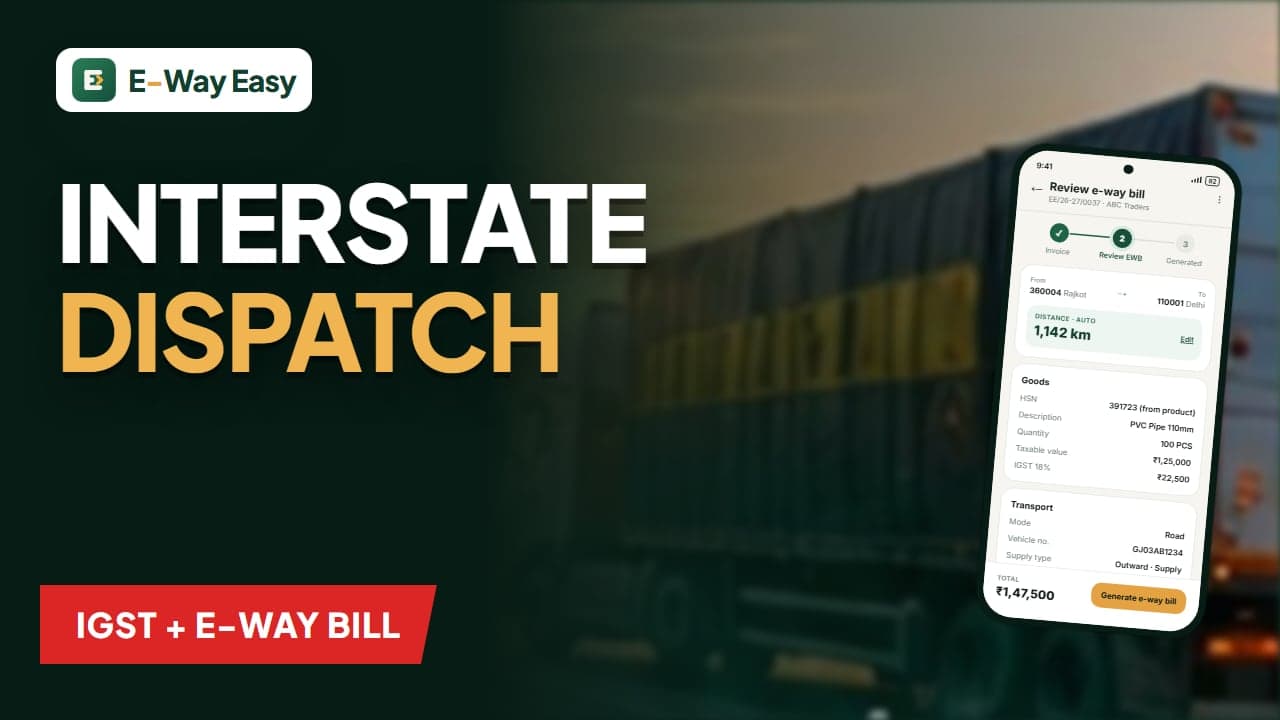
Table of contents
- When inter-state movement needs an e-way bill
- Place of supply and IGST: getting Part A right
- Long routes: distance, validity and extensions
- Vehicle changes, trans-shipment and other modes
- Transfers to your own branch in another state
- Example (illustrative): Ludhiana to Kolkata
- Common mistakes in inter-state e-way bills
- Quick action checklist
- Official sources
Quick answer: Inter-state movement generally needs an e-way bill when consignment value exceeds ₹50,000. It is needed at any value for goods sent to a job worker in another state and for specified handicraft goods moved by a person exempt from registration. The invoice must show IGST, and state-specific higher limits do not apply.
When goods leave your state, the e-way bill becomes non-negotiable in more cases. The truck may cross several states, an officer in any of them can stop it, and your home state's relaxations stop helping. This article covers what only cross-border loads need: the tests, the IGST invoice, long-route validity and vehicle changes on the way.
When inter-state movement needs an e-way bill
Inter-state movement needs an e-way bill when the consignment value exceeds ₹50,000. Consignment value is the document value including GST, excluding exempt goods on the same document. Two inter-state cases need one at any value: goods sent by a principal to a job worker, and specified handicraft goods moved by a person exempt from registration.
| If the movement is… | Then an e-way bill is… |
|---|---|
| A sale to another state above ₹50,000 | Required |
| A sale to another state at or below ₹50,000 | Not required under the general rule |
| Goods to a job worker in another state, any value | Required |
| Specified handicraft goods by a person exempt from registration | Required at any value |
| Goods covered by the Annexure to Rule 138(14) | Not required; read the condition first |
Your home state's higher limit is irrelevant once goods cross a border. A business used to a relaxed local limit often carries that habit into its first inter-state orders. That is where unplanned detentions start.
The job work case catches small lots. A ₹15,000 box of parts to a job worker in the next state still needs an e-way bill. See e-way bill rules for job work.
Place of supply and IGST: getting Part A right
An inter-state supply is one where your location and the place of supply are in different states. Such a supply carries IGST, not CGST + SGST. Part A copies its data from the invoice, so the tax type, recipient state and delivery PIN must be right on the invoice first.
Prepare the consignment in this order:
- Confirm the place of supply. Compare your state code with the buyer's GSTIN and the actual delivery address. For bill-to-ship-to orders, work it out carefully; see CGST, SGST and IGST explained.
- Raise the invoice with IGST. Show both GSTINs (or URP), place of supply with state name and code, HSN and IGST rate per line, taxable value and IGST amount.
- Fill Part A. Supplier and recipient GSTIN, delivery PIN, document number and date, value, HSN, reason for transport and transporter ID if known.
- Fill Part B with the vehicle number, or the transport document number for rail, air or ship.
- Hand over the documents. The driver carries the invoice and the e-way bill as a printout, number or RFID mapping.
Bill-to-ship-to is where inter-state Part A goes wrong most. The ship-to PIN drives distance and validity, while the place of supply drives the tax type. They can sit in different states, so check each field against the right address.
An unregistered buyer in another state is simple once you know the trick. Enter URP for the recipient, but still enter the correct state and delivery PIN. The supply is still inter-state, so IGST applies.
Long routes: distance, validity and extensions
E-way bill validity is one day for every 200 km or part of it for normal cargo, and one day per 20 km for over-dimensional cargo. The first day ends at midnight of the day after generation. Inter-state routes are long, so the distance you enter decides how many days the driver gets.
| Distance | Normal cargo validity |
|---|---|
| Up to 200 km | 1 day |
| 201–400 km | 2 days |
| 401–600 km | 3 days |
| 1,000 km | 5 days |
| 1,850 km | 10 days |
The portal calculates PIN-to-PIN distance. You can enter up to 10% more than that figure, with a 4,000 km ceiling. On a long route, rounding down to "about 1,500" instead of the real 1,620 km can cost a day of validity.
Validity is counted from when Part B is first entered. So if goods sit at a transporter's hub for a day before the long haul, filling Part B just before departure keeps the full window for the road.
If goods cannot reach in time because of an accident, a natural calamity, a law-and-order problem or a trans-shipment delay, validity can be extended within 8 hours before or after expiry. As reported by GSTN, from 1 January 2025 total extension is capped at 360 days from original generation. See what to do when an e-way bill expires.
Vehicle changes, trans-shipment and other modes
One e-way bill covers the whole inter-state journey. You never regenerate it at a border. When the vehicle changes, through a breakdown, trans-shipment at a hub or a switch to rail, you update Part B before the goods move again, while Part A stays the same.
What changes by mode:
| Mode | What goes in Part B |
|---|---|
| Road | Vehicle number |
| Rail | Railway receipt (RR) number and date |
| Air | Airway bill number and date |
| Ship | Bill of lading number and date |
Long-haul loads often pass through a hub where one truck picks up several consignments. The transporter can then generate a consolidated e-way bill (EWB-02) for the vehicle. Each consignment still needs its own valid e-way bill underneath.
The common gap is timing. The new vehicle leaves the hub first and Part B is updated "once it is on the highway". If an officer stops it before that, the vehicle on the road does not match the record.
Transfers to your own branch in another state
A stock transfer to your own branch in another state is not a simple internal movement. The branch has its own GSTIN, so the law treats the two as distinct persons. The transfer is usually a supply, with a tax invoice and IGST, and the normal e-way bill threshold applies.
Businesses used to moving stock between same-state godowns on a challan often reuse that habit across state lines. Within one GSTIN a challan may fit; across a border it generally does not. Confirm the valuation and treatment for your own case with your adviser.
Example (illustrative): Ludhiana to Kolkata
This example shows a long-haul inter-state sale from start to finish. It covers the IGST invoice, the distance and validity, and a breakdown in a third state. The fix is a Part B update by the transporter, not a new e-way bill, because one e-way bill covers the full route.
A Ludhiana hosiery manufacturer (GSTIN 03ABCDE1234F1Z5) sells knitwear worth ₹2,40,000 plus 5% IGST to a wholesaler in Kolkata (GSTIN 19PQRSX5678K1ZV). A transporter's truck collects the goods from the factory.
- Invoice: taxable value ₹2,40,000, IGST ₹12,000, total ₹2,52,000; place of supply West Bengal (19).
- Part A: both GSTINs, Kolkata delivery PIN, invoice number and date, ₹2,52,000, HSN for the knitwear, reason "Supply".
- Part B: the truck number, entered just before the truck leaves.
- Distance: the portal calculates roughly 1,700 km (illustrative), so validity is 9 days.
In Uttar Pradesh, the truck breaks down and the load moves to a replacement vehicle. The transporter updates Part B with the new number before the goods move on. No new e-way bill is needed.
Common mistakes in inter-state e-way bills
Inter-state mistakes usually come from habits that work at home but fail across a border. These include CGST + SGST on an inter-state invoice, relying on your state's higher limit, and skipping small job work lots. Long routes also punish an underestimated distance and a late Part B update.
- CGST + SGST on an inter-state invoice. The invoice is wrong, and so are the e-way bill's tax heads.
- Wrong state code for the recipient. This usually comes from typing a GSTIN by hand. Verify it before use.
- Assuming your home state's higher limit applies. It does not for inter-state movement.
- Forgetting job work. Inter-state lots to a job worker need an e-way bill even at low value.
- Underestimating distance. Too short a distance gives too little validity on a long route.
- Moving branch stock on a challan across states. Different GSTINs usually mean a tax invoice.
- Generating with an old invoice. As reported by GSTN, from 1 January 2025 an e-way bill cannot be generated for a document dated more than 180 days before generation.
Moving goods without a valid e-way bill can lead to detention and penalty under Section 129 of the CGST Act. On an inter-state load, the goods may be stopped far from your office, which makes the delay worse.
Shipping only within your own state? The rules that differ there, such as state limits and short-leg relief, are covered in intra-state e-way bill considerations.
Quick action checklist
- Add a "place of supply" check to every inter-state order before the invoice is raised.
- Flag bill-to-ship-to orders and check the ship-to PIN and the tax type separately.
- Enter the full calculated distance, not a rounded-down figure.
- Ask transporters to update Part B before any replacement vehicle moves.
- Review how you move stock to branches in other states with your adviser.
Planning a long route? The free distance calculator estimates the distance and validity before dispatch, so you know how many days the driver gets.
Official sources
Confirm current rules on the E-Way Bill System or the E-Way Bill 2.0 portal, the GST portal and CBIC GST. Rules and portal features change, so check before relying on any figure here.
Frequently asked questions
Do state-specific higher thresholds apply to inter-state movement?
No. Higher thresholds notified by some states apply only to movement within that state. For inter-state movement, the general threshold under Rule 138 applies.
Can an unregistered buyer in another state receive goods under an e-way bill?
Yes. The supplier generates the e-way bill and enters URP (unregistered person) in place of the recipient GSTIN, with the correct state and delivery PIN. The invoice still carries IGST, because the supply crosses a state border.
Does the e-way bill need to be regenerated at the state border?
No. One valid e-way bill covers the whole journey, through every state on the route. Only Part B needs updating if the vehicle changes.
Does sending stock to my own branch in another state need an e-way bill?
Generally yes, if the value crosses the threshold. A branch in another state has its own GSTIN, so the transfer is usually a supply between distinct persons, with a tax invoice and IGST.
Sources and references
- E-Way Bill System (official portal)ewaybillgst.gov.in
- E-Way Bill 2.0 portalewaybill2.gst.gov.in
- CBIC GSTcbic-gst.gov.in
- GST portalwww.gst.gov.in
This article is general information, not tax or legal advice. GST and e-way bill requirements depend on the transaction, applicable notifications and state-specific provisions. Check the official portals before you rely on it.
Written by
Bhavesh AkabariBhavesh Akabari writes and edits the E-Way Easy guides on e-way bills, GST invoicing and day-to-day compliance workflows for Indian manufacturers, wholesalers and traders. Drafts are prepared with AI assistance; he edits each one and checks the facts against official GST and e-way bill sources, and every compliance article carries a "last verified" date.
How we create contentRelated articles
E-Way Bill Considerations for Intra-state Movement
Moving goods within your own state? Thresholds and local exemptions can differ by state. Here is how to work out what applies and avoid common slip-ups.
By Bhavesh Akabari · · 7 min read
CGST vs. SGST vs. IGST Explained
Which GST applies to your sale — CGST plus SGST, or IGST? A plain-English guide to place of supply, UTGST, credit use and costly mix-ups.
By Bhavesh Akabari · · 7 min read
What to Do When an E-Way Bill Expires
Goods stuck on the road and the e-way bill about to lapse? Learn the 8-hour extension window, how validity is recalculated and what to avoid.
By Bhavesh Akabari · · 5 min read