E-Way Bill Rules for Job Work
When goods go to a job worker and come back, who generates the e-way bill, which document travels with the goods, and why inter-state job work needs one at any value.
Last verified against official sources: 16 Oct 2026
Drafted with AI assistance, edited and fact-checked by a person. How we write and check our guides
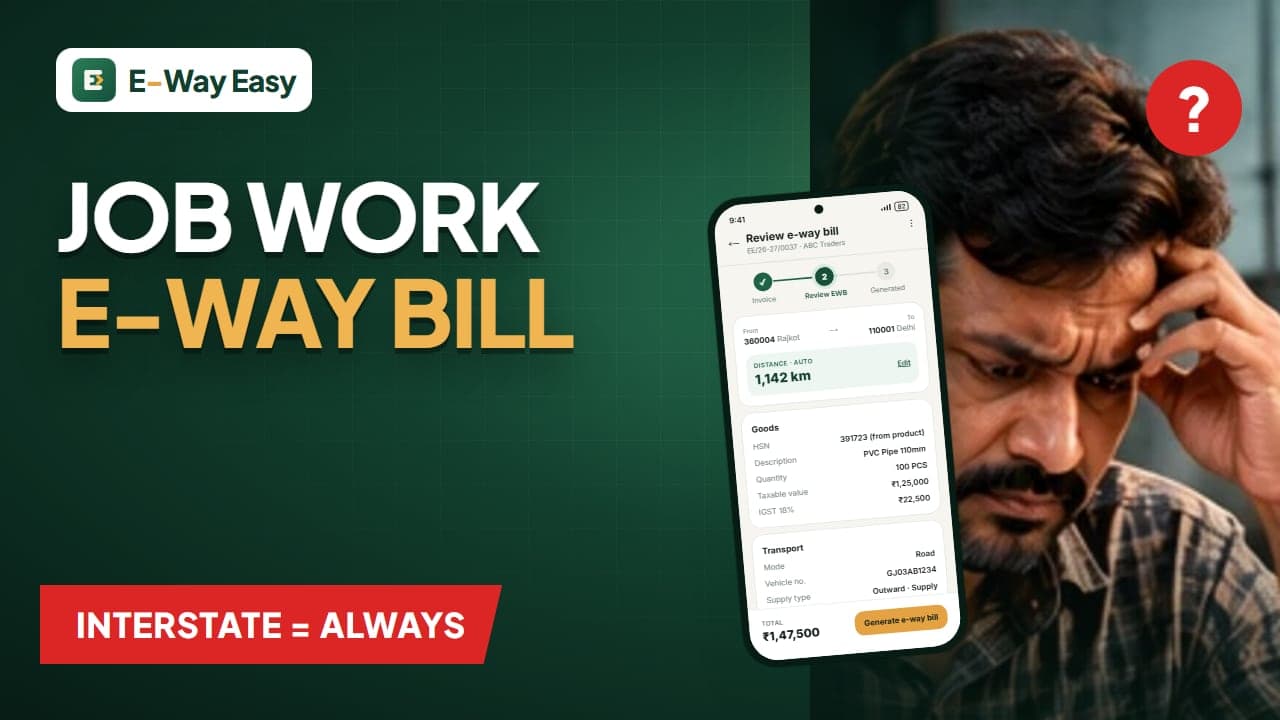
Table of contents
Quick answer: For inter-state movement from a principal to a job worker, an e-way bill is required at any value. The principal or a registered job worker generates it against a delivery challan. For job work within a state, the normal threshold applies: generally ₹50,000, or the limit your state has notified.
Job work is everywhere in Indian manufacturing. A trader sends grey fabric for dyeing, an engineering unit sends castings for machining, a brand sends cut pieces for stitching. Because no sale happens when goods go out, many businesses assume the e-way bill rules do not apply, and that is the most common job work mistake.
The key rule
Under a proviso to Rule 138(1) of the CGST Rules, goods sent by a principal in one state or UT to a job worker in another need an e-way bill irrespective of value. The principal can generate it, or the job worker if registered. For job work within one state, the normal threshold applies, so check your state's limit.
| If… | Then… |
|---|---|
| Principal and job worker are in different states, goods going out | E-way bill at any value |
| Principal and job worker are in the same state | E-way bill only if value crosses your state's limit |
| Goods coming back from the job worker | Normal threshold test |
| Job worker is unregistered | The principal generates |
The rule is one-directional. It covers goods sent by the principal to a job worker across states. Teams that learn "job work needs an e-way bill at any value" often over-apply it to the return leg and to same-state job work.
Who does what
Responsibility in job work depends on the direction of movement, and each leg is tested separately. Outward lots go on the principal's challan, generated by the principal or a registered job worker, and returns go on a challan from the job worker's side. Goods sent straight from the job worker to a buyer go on the principal's tax invoice.
| Movement | Document | E-way bill required? | Usually generated by |
|---|---|---|---|
| Principal → job worker, different states | Delivery challan | Yes, at any value | Principal, or registered job worker |
| Principal → job worker, same state | Delivery challan | If value crosses the applicable threshold | Principal (or transporter/job worker as applicable) |
| Job worker → principal (return after processing) | Delivery challan | If value crosses the applicable threshold | Job worker if registered, or principal/transporter |
| Job worker → another job worker | Delivery challan | Same tests as above | Principal or registered job worker |
| Job worker → principal's buyer (direct supply) | Tax invoice issued by the principal | If value crosses the threshold | Principal (or as per arrangement) |
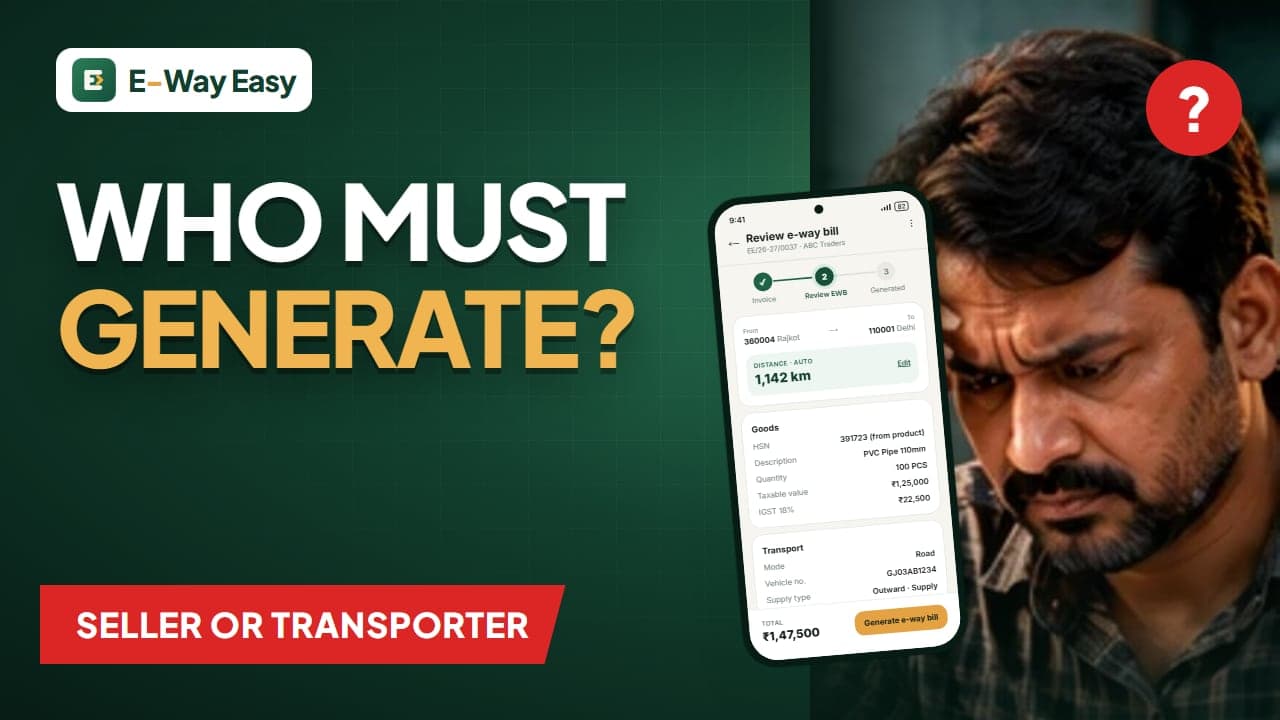
For the return from an unregistered job worker, the registered principal can generate it as the recipient causing the movement. Direct supply from the job worker's premises has its own conditions under Section 143, so check them first. For the wider rules on who generates, see who is responsible for generating an e-way bill.
The delivery challan for job work
Job work is not a supply, so the goods travel on a delivery challan under Rule 55, not a tax invoice. The challan carries the date and number, both parties' details, HSN and description, quantity, value and place of supply for inter-state movement. On the portal, choose delivery challan as the document type and job work as the reason.
A job work challan should carry:
- Date and a serially numbered challan number
- Name, address and GSTIN of the consignor
- Name, address and GSTIN (if registered) of the consignee
- HSN code and description of goods
- Quantity
- Taxable value
- Tax rate and tax amount, only where the movement is for supply to the consignee. Job work is not a supply, so no tax is charged; some businesses show the rate for reference.
- Place of supply, in case of inter-state movement
- Signature
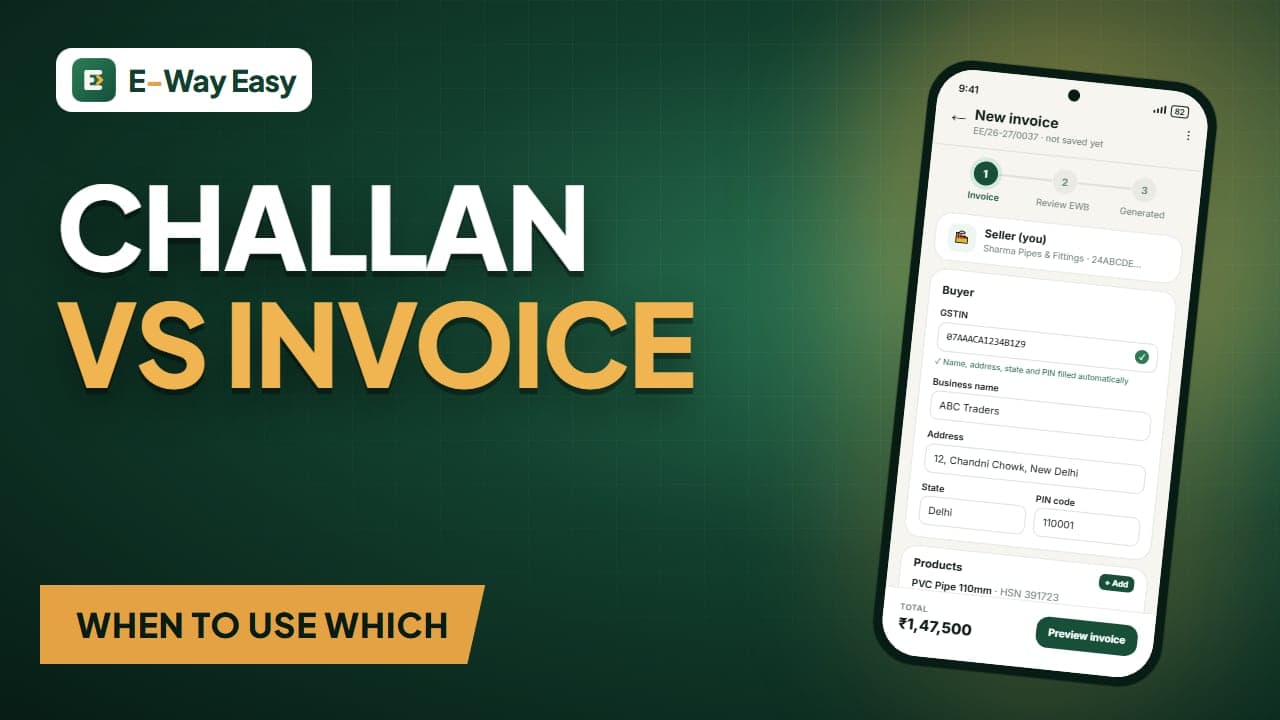
For the return leg, the portal provides a job work return option. For the difference between the two documents, see delivery challan vs tax invoice.
Valuing the challan
Value the goods realistically, usually the value of the inputs or semi-finished goods you send. The job worker's charges are not part of the outward challan. Undervaluing does not avoid the e-way bill for inter-state job work anyway, and a value that looks wrong invites questions during inspection.
Step-by-step: sending goods for inter-state job work
Sending goods for inter-state job work takes five steps. Raise a delivery challan, generate the e-way bill from it with job work as the reason, fill Part B with the vehicle, send the goods with the challan copies, and record the lot in your job work register. The register is what lets you prove the goods came back.
- Raise the delivery challan in your own series, with the job worker's GSTIN or details.
- Generate the e-way bill with Part A from the challan: both GSTINs, delivery PIN, challan number and date, value, HSN, reason "Job Work".
- Fill Part B with the vehicle number.
- Send the goods with the challan in triplicate: original for the consignee, duplicate for the transporter, triplicate retained by you.
- Record the movement in your job work register, so you can track return time limits and report as the job work provisions require.
Build the register so it handles partial returns. Fabric comes back in two or three lots, with some waste or scrap. A simple sheet with challan number, quantity sent, quantity returned per lot, waste and balance shows at a glance what is still out.
Example (illustrative): grey fabric to Surat and back
This example shows a low-value inter-state job work lot. The outward lot is below ₹50,000 but still needs an e-way bill, because it goes from principal to job worker across states. The return leg is tested on the normal threshold, and the dyer's own service charges go on a separate tax invoice.
A Bhiwandi textile trader (GSTIN 27ABCDE1234F1Z5) sends 600 metres of grey fabric, valued at ₹42,000, to a dyeing unit in Surat (GSTIN 24PQRSX5678K1Z4).
- The value is below ₹50,000, but this is inter-state movement from principal to job worker, so an e-way bill is required.
- The trader issues delivery challan
DC/26-27/0118. - The e-way bill uses document type "Delivery Challan", reason "Job Work", the dyeing unit's PIN and the tempo's number in Part B.
Two weeks later, the dyed fabric comes back, and the dyeing unit checks whether this return leg's value crosses the threshold. If it does not, and no other condition applies, an e-way bill may not be required, but the goods still travel on a challan. Generating one voluntarily is allowed.
Separately, the dyer issues a tax invoice for its job work charges, with GST as applicable.
Common mistakes
Job work mistakes start with the belief that no sale means no e-way bill. Others follow: a tax invoice instead of a challan, the "Supply" reason instead of job work, an unregistered job worker trying to generate, and no register to track goods sent. Each one makes the movement look like something it is not.
- No e-way bill because "it's not a sale". For inter-state principal-to-job-worker movement, value and the absence of a sale do not matter.
- Using a tax invoice instead of a delivery challan. This makes the movement look like a sale and creates a mismatch in returns.
- Wrong reason code. Selecting "Supply" instead of job work misdescribes the movement.
- Unregistered job worker generating the e-way bill. For inter-state movement, only a registered job worker can; otherwise the principal should.
- Losing track of goods at the job worker. Inputs and capital goods must come back within the time limits in the law, or the movement may be treated as a supply.
- Mixing up the job worker's charges with the movement documents. The service invoice is separate.
Limitations
This article covers the e-way bill side of job work only. The wider provisions in Section 143 of the CGST Act, including return time limits and reporting, have their own conditions. Discuss your arrangement with an adviser, especially where goods move direct from the job worker to buyers or between several job workers.
The documents required for an e-way bill guide lists what the driver should carry on each leg.
Quick action checklist
- List your job workers and mark which are in another state and which are registered.
- Set a rule: every inter-state outward job work challan gets an e-way bill, whatever the value.
- Start a job work register with challan number, quantity sent, returns by lot, waste and balance.
- Check the reason on the portal: the job work option for goods going out, the job work return option for goods coming back.
- Review open challans monthly against the return time limits in the law.
Need a job work challan today? The free delivery challan generator creates a numbered challan for job work, transfers and approval that you can print or save as PDF.
Official sources
Read the current text of Rule 138 and Rule 55 on CBIC GST or CBIC. See the E-Way Bill System and GST tutorials for how to select the job work options when generating.
Frequently asked questions
Is an e-way bill needed if I send ₹15,000 worth of goods to a job worker in another state?
Yes. For inter-state movement from a principal to a job worker, Rule 138 requires an e-way bill irrespective of the consignment value.
Can the job worker generate the e-way bill?
For inter-state movement from principal to job worker, the e-way bill can be generated by the principal, or by the job worker if registered. An unregistered job worker cannot, so the principal should.
Which document should travel with goods sent for job work?
A delivery challan, because sending goods for job work is not a sale. The e-way bill is generated against the challan, with delivery challan as the document type and job work as the reason.
Does the return from the job worker also need an e-way bill at any value?
Not under the 'any value' rule, which covers goods sent by a principal to a job worker across states. For the return leg, apply the normal threshold and verify the current position with your adviser.
Sources and references
- E-Way Bill System (official portal)ewaybillgst.gov.in
- CBIC GSTcbic-gst.gov.in
- CBICwww.cbic.gov.in
- GST tutorialstutorial.gst.gov.in
This article is general information, not tax or legal advice. GST and e-way bill requirements depend on the transaction, applicable notifications and state-specific provisions. Check the official portals before you rely on it.
Written by
Bhavesh AkabariBhavesh Akabari writes and edits the E-Way Easy guides on e-way bills, GST invoicing and day-to-day compliance workflows for Indian manufacturers, wholesalers and traders. Drafts are prepared with AI assistance; he edits each one and checks the facts against official GST and e-way bill sources, and every compliance article carries a "last verified" date.
How we create contentRelated articles
Delivery Challan vs. Tax Invoice
Not every movement of goods is a sale. Learn when to issue a delivery challan instead of a tax invoice, what each must contain and how e-way bills fit in.
By Bhavesh Akabari · · 8 min read
Who Is Responsible for Generating an E-Way Bill?
Supplier, recipient or transporter? How responsibility for the e-way bill is split, what each party must do, and how to avoid goods leaving without one.
By Bhavesh Akabari · · 7 min read
E-Way Bill Requirements for Inter-state Movement
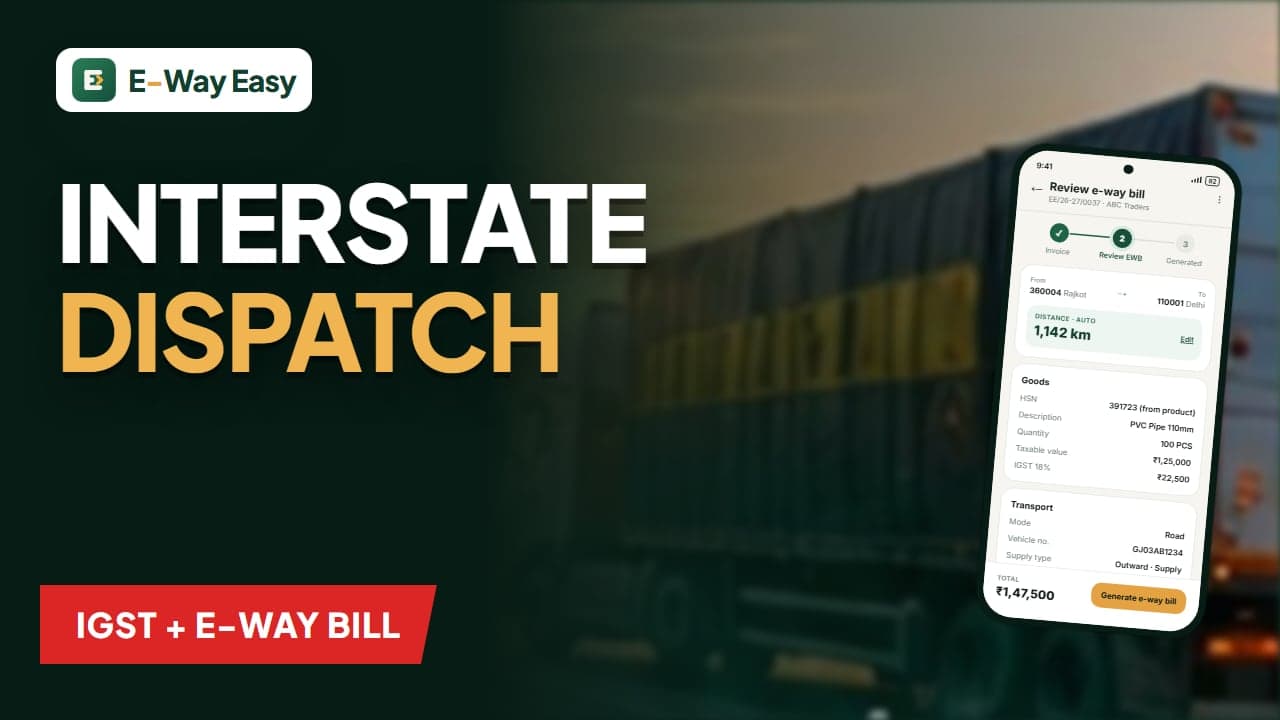
What changes when goods cross a state border: the ₹50,000 threshold, cases needing an e-way bill at any value, IGST, distance, validity and documents to carry.
By Bhavesh Akabari · · 8 min read